QuaBioNHy
ANR-23-CE44-0013
Competitive national funding supporting the development of nanopore approaches for the identification and quantification of peptide biomarkers.
Principal Investigator
My research programme is developed within LAMBE and supported through competitive projects, national research programmes, regional initiatives and translational collaborations.
ANR-23-CE44-0013
Competitive national funding supporting the development of nanopore approaches for the identification and quantification of peptide biomarkers.
 CY INITIATIVE · EMERGENCE · 2021–2024
A single-molecule and single-cell approach developed within LAMBE – Biology.
CY INITIATIVE · GÉNÉRATIONS PNADS · 2025–2030Leadership of a strategic programme focused on reading and decoding molecular information encoded in sequence-defined polymers using biological nanopores at the single-molecule level.
Collaborative research on sequence-defined and digital polymers and molecular information storage. The separate PNADS programme focuses specifically on biological-nanopore reading and decoding.
Nanopore approaches to molecular species relevant to energy materials, including lithium–sulfur battery chemistry.

Biomarker-oriented research for sepsis, linking single-molecule analysis, solid-state nanopores and translational diagnostics.
Regional support for nanopore research and its applications in biological analysis.
2021–2024 · Support for the project on low-copy biomarker identification at the single-molecule and single-cell levels.
2025–2030 · A major programme led by Benjamin Cressiot on molecular information storage, with biological nanopores used to read and decode information encoded in sequence-defined polymers.
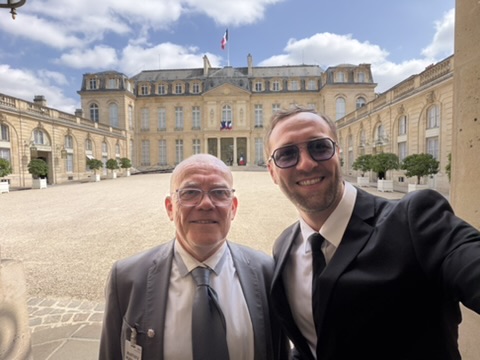
On 23 July 2026, Benjamin Cressiot and Pierre Defrenaix, from Excilone, met at the Palais de l’Élysée to discuss the future of DreamPore, a startup hosted at CY Cergy Paris Université in which Benjamin Cressiot also contributes scientifically.
The discussion focused on nanopore-based biomarker diagnostics, technology transfer and the development of French technological sovereignty in molecular analysis.
Intellectual property: nanopore-related technology transfer includes patent EP3270139B9. This research-to-innovation pathway complements fundamental investigations in molecular sensing.
Potential collaborations are especially relevant in peptide and protein analysis, disease biomarkers, digital polymers, molecular modelling and energy materials.